Turnaround Time 24-48 Hours!

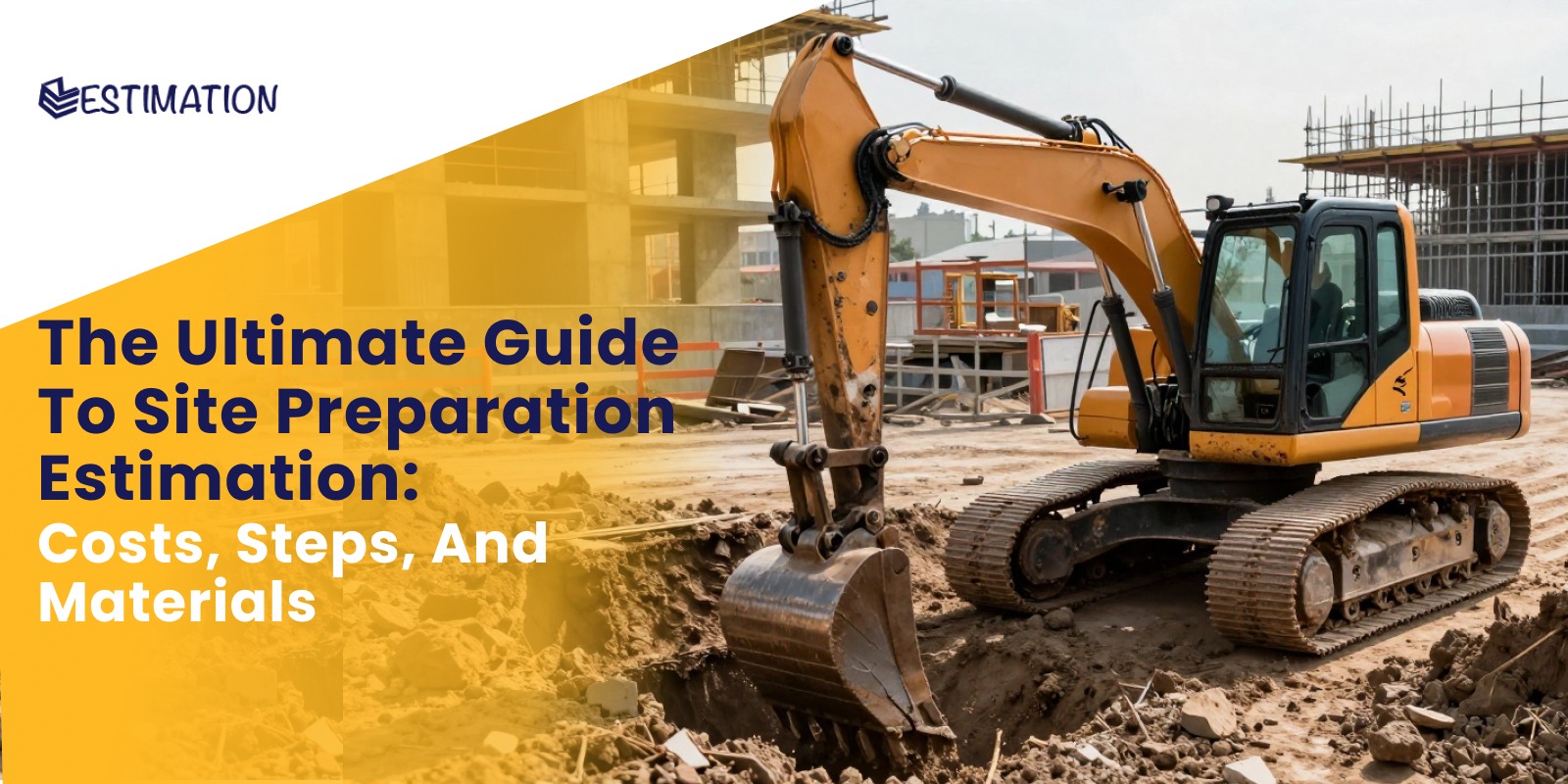
Dirt work is where projects go wrong before they even start. A foundation pad that sits six inches too high, a drainage channel that was never modeled in the estimate, a haul road that the original budget completely forgot about, these are not edge cases. They are the predictable outcomes of treating site preparation as an afterthought rather than a discipline.
Professional site preparation estimation services exist precisely to close that gap. A proper estimate does not just count cubic yards of dirt. It sequences the work, identifies subsurface risk, accounts for regulatory compliance, and produces a number that holds up under real field conditions. For residential builders and commercial developers alike, getting this piece right before mobilization is the difference between a project that starts on budget and one that is already underwater by the time footings are poured.
This guide covers the full picture: what site prep actually involves, what drives costs across different project types, how to approach earthwork and grading cost estimation with accuracy, and what to look for when selecting a professional estimating partner.
Ask ten contractors what site prep includes and you will get ten slightly different answers. The honest answer is that it depends on the site, the structure going on it, and the jurisdiction governing the work. That said, there is a core set of activities that appear on nearly every project, and understanding them is the starting point for any credible construction site preparation estimating effort.
Site clearing is typically the first mobilization task. This means removing existing vegetation, trees, stumps, and debris from the footprint of the work area and any necessary buffer zones. Site clearing cost calculation has to account for tree density, species (hardwoods cost more to remove than softwoods), disposal or chipping logistics, and whether any material will be chipped on-site for use as erosion control mulch.
Residential site prep estimating is largely driven by lot-level variables: size, topography, soil type, existing vegetation, and proximity to utilities. Most residential estimates can be structured around a handful of line items, clearing and grubbing, rough grade, fine grade, erosion control, and any driveway or apron preparation.
The complexity multiplies on custom home sites, particularly on lots with significant slopes, high-water-table conditions, or engineered fill requirements. A hillside lot that requires a retaining wall and extensive cut-and-fill balancing is a fundamentally different estimating exercise than a flat suburban infill lot, even if the finished footprints are identical.
Residential site prep estimating also has to account for the fact that most residential contracts are lump-sum, not unit-price. That means the estimator carries the risk of quantity variations. Building in appropriate contingencies and doing a proper sitework takeoff before finalizing a number is not optional on difficult residential sites.
Commercial site preparation estimating services operate at a different level of complexity. Civil drawings on commercial projects include grading plans, utility plans, erosion control plans, and often geotechnical reports with specific subgrade preparation requirements. A professional estimator working a commercial site package will extract quantities from each of these documents independently, then reconcile them against the specifications.
Mass earthwork on commercial sites, particularly retail, industrial, and mixed-use developments, often involves large-volume cut and fill operations where the balance between imported and exported material determines a significant portion of the total cost. An earthwork and grading cost estimation that misses the fill balance by 5,000 cubic yards on a large project can translate to a six-figure budget gap.
A site prep estimate is only as good as the takeoff underneath it. Sitework takeoff services use digital measurement tools, typically Bluebeam, Trimble Business Center, or similar platforms, to extract precise earthwork volumes, clearing areas, and linear footage quantities from civil drawings.
The core of any earthwork takeoff is the mass haul calculation: how much material is being cut, how much is being filled, what is the net import or export, and where does it go. This calculation requires both the existing grade surface and the proposed grade surface, derived from the grading plan and any topographic survey data. The volume difference between these surfaces is the net earthwork quantity. Compaction factors, swell factors, and shrinkage factors are then applied based on the soil type identified in the geotechnical report.
Clearing and demolition takeoffs measure the area of vegetation removal, the linear footage of any fence lines or structures to be demolished, and the locations and approximate sizes of trees requiring individual removal. These feed directly into the site preparation materials estimation for equipment selection and disposal logistics.
The most common failure mode in site prep budgeting and planning is not mathematical error. It is a scope omission. Projects regularly go over budget on site prep because items that should have been in the original estimate were simply never identified, mobilization and demobilization costs, testing and inspection fees, permit costs for grading and land disturbance, and stormwater pollution prevention plan preparation costs are all real line items that belong in the budget from day one.
A complete site prep budgeting and planning exercise should include a contingency analysis tied to the specific risk profile of the site. Flat, well-documented sites with recent geotechnical investigations carry lower contingency needs, typically 5 to 10 percent. Sites with limited subsurface data, known karst geology, or high-water-table conditions warrant contingencies of 15 to 25 percent or more. Carrying the wrong contingency percentage is just as problematic as missing a line item.
Not every estimating firm understands dirt work at the level that accurate site prep requires. When evaluating a provider of site preparation estimation services, the following qualifications matter:
The right partner does not hand you a number on a one-page summary. They hand you a document you can defend to your client, your lender, and your own field team on day one of construction.
Site preparation is where the physical reality of a project diverges most sharply from the assumptions that went into the design. Soil conditions, drainage patterns, buried obstructions, and weather all hit hardest at grade. A thorough, properly scoped estimate does not eliminate these risks, but it prices them correctly so that when they show up, they do not become financial emergencies.
Whether the project is a single-family custom home on a challenging lot or a multi-acre commercial development with complex civil infrastructure, the investment in professional site preparation estimation services pays back in fewer surprises, tighter budget performance, and bids that reflect what the work actually costs. In a market where margins are thin and scope disputes are expensive, that kind of accuracy is not a nice-to-have. It is a competitive requirement.

We estimate clearing, temporary facilities, erosion control, and complete site mobilization.










EZ Estimation is a professional consultancy specializing in providing construction cost estimates. The company is offering construction cost estimating and take off services to the general contractors, engineering firms, developers, subcontractors, owners and investors.

SERVICES
Contact Info
© 2025, ezestimation All rights reserved