Turnaround Time 24-48 Hours!

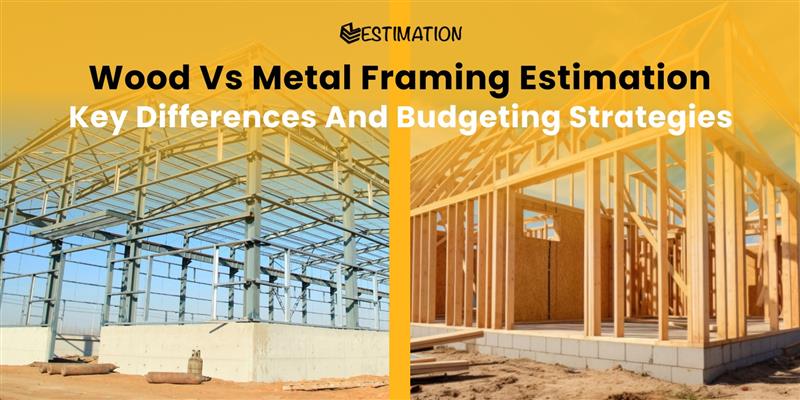
Framing is the skeleton of any building. Get it right and everything else follows. Get it wrong and you are dealing with structural problems, budget overruns, and rework that nobody planned for.
One of the first decisions every builder, developer, or contractor faces is the choice between wood and metal framing. It sounds simple. It is not.
The materials behave differently. They cost differently. They require different labor skills. And they are estimated differently.
Wood vs. metal framing estimation is not just a numbers exercise. It is a strategic decision that shapes your project budget from the ground up. This article breaks down the key differences and gives you practical budgeting strategies for both.
Framing estimation is the process of calculating the total cost to frame a structure. It covers materials, labor, fasteners, waste allowances, and any specialist equipment required.
A good framing estimate does several things. It gives you a reliable budget baseline. It helps you compare contractor bids fairly. It identifies where cost risk sits. And it tells you whether your design is financially viable before any work begins.
Poor framing estimates create problems downstream. Underpriced materials lead to budget gaps. Overlooked labor complexities push timelines out. Missed waste factors mean you run short of materials mid-build.
Whether you are estimating construction costs for a residential home, a commercial fit-out, or a large industrial project, framing is one of the biggest line items on the budget. It deserves serious attention.
Wood has been the dominant framing material in residential construction for generations. It is familiar, widely available, and easy to work with.
Wood framing advantages are well established. Timber is lighter than metal and easier to cut, shape, and fasten on site. It requires no specialist tools beyond standard carpentry equipment. Most contractors and subcontractors have the skills to work with it.
Moreover, wood also offers natural thermal insulation properties. It is easier to modify during construction if design changes arise. And for residential builds in most markets, timber suppliers are plentiful and pricing is competitive.
From an estimation standpoint, wood framing is relatively straightforward to quantify. Linear footage calculations, standard section sizes, and well-understood waste factors make takeoff manageable for experienced estimators.
Material costs for wood framing vary depending on timber species, grade, section size, and market conditions. Lumber prices are notoriously volatile. They spiked dramatically in recent years and have remained unpredictable since.
This is one of the biggest risks in wood vs. metal framing cost planning. An estimate prepared months before procurement can be significantly out of step with actual market pricing by the time materials are purchased.
Labor costs for wood framing are generally lower than for metal. Skilled carpenters are more widely available than light gauge steel framing specialists in most markets, which keeps hourly rates more competitive.
Waste allowances for timber typically run between 10 and 15 percent depending on the complexity of the design and the cutting patterns involved.
Metal framing particularly light gauge steel (LGS), has grown steadily in commercial and multi-residential construction over the past two decades. It offers properties that wood simply cannot match in certain applications.
Metal framing advantages center on precision, durability, and performance. Steel sections are manufactured to exact tolerances. They do not warp, shrink, or twist the way timber can over time. For large commercial projects where dimensional consistency is critical, that reliability has real value.
Steel is also non-combustible. In commercial and high-rise applications where fire ratings are a compliance requirement, metal framing can simplify the fire protection design and reduce the need for additional protective treatments.
Metal framing is also resistant to termites and rot. In regions where biological deterioration is a genuine concern, this cuts long-term maintenance costs significantly.
From a sustainability standpoint, steel has strong recycled content credentials and is fully recyclable at end of life. For projects targeting green building certifications, this matters.
Metal framing estimation is more complex than wood in several respects. Steel sections come in a wide range of gauges and profiles, and selecting the correct specification requires structural input. Under-specifying to save money creates compliance and structural risk.
Material costs for metal framing are generally higher per linear foot than equivalent timber sections. However, the gap narrows when you factor in the precision of steel. Waste factors for metal framing are typically lower than for wood, often running between 5 and 8 percent, because steel sections are cut more accurately and off-cuts can often be reused.
Labor costs for metal framing are higher. Installers need familiarity with LGS systems, specialist fastening equipment, and the specific sequencing requirements of steel frame construction. In markets where these skills are less common, the labor premium can be significant.
When doing a direct framing costs comparison, the numbers alone do not tell the whole story. Context matters.
For a standard single-family residential build, wood framing will almost always come in lower on both material and labor costs. The familiarity of the system, the availability of contractors, and the simplicity of the takeoff all work in timber’s favor.
For commercial construction, multi-story residential, or any project with strict fire or durability requirements, metal framing often makes more financial sense over the full project lifecycle. Higher upfront costs are offset by tighter tolerances, lower waste, reduced maintenance, and compliance advantages.
A like-for-like framing costs comparison should always include material, labor, waste, fasteners, any specialist equipment hire, and the cost implications of the structural design required for each system.
Regardless of which material you choose, budgeting for framing projects requires discipline and precision. Here are the strategies that experienced estimators apply.
Lock in material pricing early. Lumber prices fluctuate. Steel prices move with global commodity markets. Get firm supplier quotes as close to procurement as possible and build an escalation allowance into your budget if there is a long lead time between estimate and purchase.
Use accurate quantity takeoff. Sloppy takeoff is the root cause of most framing budget failures. Measure carefully, apply appropriate waste factors for the material type, and cross-check your quantities against the structural drawings before finalising the estimate.
Understand your labor market. Framing project budgeting tips from experienced cost managers consistently highlight labor as the variable most likely to be underestimated. Know your local market rates and confirm contractor availability before fixing your labor budget.
Build in a contingency. A contingency of 10 percent on framing budgets is a sensible baseline. For complex designs, unusual site conditions, or projects using less familiar framing systems, increase that to 15 percent.
Consider the full lifecycle cost. Upfront material and labor costs are only part of the picture. Cost-effective framing options are not always the cheapest to install. Factor in long-term durability, maintenance requirements, and the cost implications of future modifications when making your material choice.
There is no universal answer to the wood vs. metal framing debate. The right choice depends on your project type, location, budget, timeline, and long-term performance requirements.
Wood framing makes sense for most residential projects where cost, speed, and contractor availability are the priority. Metal framing makes sense for commercial builds, multi-story structures, and projects where fire resistance, precision, or durability requirements tip the balance.
The key is making the decision based on the full picture rather than upfront material cost alone.
Framing is one of the most consequential decisions you make on any construction project. The choice between wood and metal touches your budget, your timeline, your compliance position, and your long-term maintenance obligations.
Wood vs. metal framing estimation is not a one-size-fits-all calculation. It requires careful analysis of materials, labor, waste, lifecycle performance, and project-specific requirements.
Plan the estimate properly. Understand your market. Compare the full cost of each option. And build your budget on accurate data rather than assumptions. Thus, do that and your framing budget will hold. Skip it and the cracks will show before the walls go up.










EZ Estimation is a professional consultancy specializing in providing construction cost estimates. The company is offering construction cost estimating and take off services to the general contractors, engineering firms, developers, subcontractors, owners and investors.

SERVICES
Contact Info
© 2025, ezestimation All rights reserved